Municipal AI governance software for Canadian local government.
Built for the CAOs, corporate services leaders, and IT teams who have to govern municipal AI use — and prove it.
Your staff are already using AI. LUMINARYX™ gives you a straightforward way to govern it — one place to document each decision, check it against the rules, route it for approval, and keep a tamper-evident record. So when a regulator or your council asks how your municipality is handling AI, you already have the answer in hand. Built for the CAO who has to stand behind those decisions at the council table.
Who it's for
One record, three roles. LUMINARYX™ gives every part of a municipality's AI governance what it needs — from the CAO who is accountable at the council table, to corporate services keeping the compliance record, to the IT team that has to deploy and secure it.
For the CAO
Defend every AI decision at the council table. Risk-classified decisions, a tamper-evident audit trail, and board-ready PDF packs mean you can always show how a call was made and who stood behind it.
For Corporate Services
Turn AI policy into compliance you can prove. Map decisions against nine Canadian frameworks and 62 requirements, upload your own policies, and keep FOI- and records-ready documentation for every AI-assisted decision. Seeded for four provinces today, with further jurisdictions in progress.
For IT
Governance that's secure, deterministic, and hosted in Canada. Data stays in AWS ca-central-1, documents are redacted in the browser, and the governance engine uses no machine learning — the same input always produces the same output.
The governance gap
Staff are already using AI. They draft reports with ChatGPT, analyze data with Copilot, and explore tools they found on their own. In most municipalities, this is happening without policy, without oversight, and without a paper trail.
Banning AI doesn't make a municipality safer. It just pushes the use out of sight, raises your liability, and lets the gains other communities are already capturing pass yours by.
And the rules aren't waiting. Ontario's Bill 194, British Columbia's FOIPPA, Quebec's Law 25, and the federal Treasury Board Directive are all moving toward requiring public bodies to govern how they use AI. The question isn't whether your municipality will have to show it's compliant. It's when.
What LUMINARYX™ does
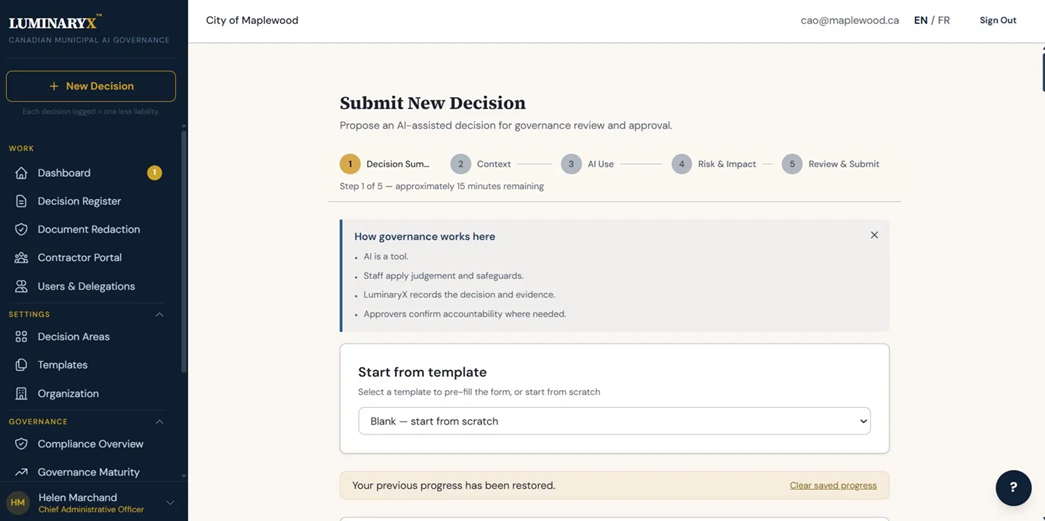
Decision register. Every AI-related decision is recorded, classified by risk, routed for approval, and logged to a tamper-evident audit trail. Every decision stays explainable on the record — when a resident, auditor, or council asks how it was made, the answer is a person's name and a clear rationale.
Compliance mapping. Nine Canadian regulatory frameworks. 62 requirements. Seeded for four provinces today, with further jurisdictions in progress. Your decisions mapped against the rules that apply in your province.
Kept current as the rules change. We maintain the Canadian frameworks and ISO standards for you. When the rules shift, your compliance mapping updates right in the platform — no re-implementation, no new project.
Contractor accountability. Consultants and vendors declare their AI use through a simple portal. Each declaration is scored against four accountability areas and linked straight to your governance record.
Configurable to your municipality. Upload your own policies. Create and customize decision templates to fit your operating context.
Delegation, when the CAO chooses. The CAO can hand specific staff time-limited permissions — like managing users or managing decisions — without giving up oversight. Every decision still rolls up to one municipal record.
Staff capability building. Structured documentation doubles as practical training. As staff record and review decisions, the platform explains the reasoning behind each step — separation of duties, human oversight, explainability — so they learn safer AI use by doing it, not from a manual.
Bilingual by design. Full English and French support, including Quebec French terminology, because governance does not stop at provincial borders.
How it works
Five plain steps, from an everyday AI decision to a record you can defend.
1. Set your rules once. You decide who signs off, when a second approval is needed, and what's too risky to decide alone. Your rules, built right into the software.
2. Start a decision. Anyone on your team can begin. The moment they submit, LUMINARYX records who owns the decision — and locks it, so responsibility can't quietly change hands later.
3. Get the right sign-offs. No one can approve their own work. Higher-risk decisions need a second person. The most serious ones are stopped and sent up the chain — because some choices are too big to automate.
4. Keep humans in charge. People decide first. Only then does the AI run its assessment and a reviewer signs off. That order is deliberate: you can never say the AI made the call.
5. Keep the proof. Every step is logged to a tamper-evident trail. When council asks, an audit lands, or a records request comes in, you have a clear answer ready.
Briefings
Public-record analysis of how artificial intelligence is appearing in the software Canadian municipalities already use, and what the governance gap looks like in practice. Sourced, dated, and offered as a contribution to municipal practice. Read the latest briefing or browse all briefings.
Built for Canadian municipalities
If your governance tool runs on AI, who governs the governance tool? LUMINARYX is fully deterministic. The same input always produces the same output, with no model behaviour to explain to council. No machine learning in the governance engine, ever.
Instead, it guides your team through structured assessments and produces a hash-chained audit trail of every decision, every assessor, every rule applied.
Hosted in Canada
AWS ca-central-1, Montreal. Your records stay under Canadian jurisdiction and Canadian privacy law.
Audit-ready
Cryptographic hash chains on every record. Any tampering after the fact is mathematically detectable.
Your data stays yours
Client-side document redaction. Documents never leave your device. Personal information is stripped in your browser before any AI model sees it, so the unredacted data never leaves your network.
Pricing
All features included. Pricing reflects the scale of your governance, not access to functionality.
We publish because we think municipalities deserve to know what governance costs before they spend an hour on a sales call. Pricing is population-based, not per seat, so your whole organization can use the platform without counting logins. Every municipality signing in the same period pays the same rate for the same population band. That is part of the fairness commitment.
Above 500,000, by agreement.
These are introductory rates, available to municipalities that sign on or before December 31, 2027.
If you sign at these rates, LUMINARYX™ will not increase your rate for three years from the date you sign. Your subscription stays annual and you are free to renew or not renew at each anniversary. There is no multi-year commitment, and you do not need to negotiate this. It is a commitment we make to you.
Included in every tier
About
LUMINARYX was founded by Joy Guyot, who brings 18 years of business operations and direct local government council experience in BC.
Before launching LUMINARYX, Joy created iQuiki Kiosk, a self-service hardware and cloud platform designed for campground operations. Her background is in building practical, working systems, not advising on them.
By 2025, AI was ready to move into municipal work, but the policy direction to govern it wasn't. In conversations with local government colleagues across Canada, the same gap kept surfacing: no clear guidance was coming.
LUMINARYX™ was built to close that gap, by someone with both direct council-table experience and the technical expertise to design and deploy the software. Municipalities need governance tools created by people who understand how local government actually operates in practice, not in theory.
LUMINARYX™ is a trademark of 17691190 Canada Inc. Joy Guyot is a member of the International Association of Privacy Professionals, working toward the IAPP's AI Governance Professional certification, and an Associate Member of MISA BC.
Frequently Asked Questions
Is a municipal AI governance policy legally required in Canada?
Not as a single named law, not yet. But municipalities are already bound by provincial privacy legislation, records and retention requirements, and the basic duty to make documented, defensible decisions. The moment AI shapes a decision that affects residents, the test is not whether you had a policy. It is whether you can show how the decision was made and who stood behind it. Governance is how you pass that test, whether or not a statute ever names it.
What happens if an AI-assisted decision turns out to be wrong?
A municipality is not expected to be infallible. It is expected to be able to account for its choices. The thing that protects you is a record, often called a decision register, that shows what the AI contributed, what a person judged, and why the call was reasonable at the time. With that, a wrong outcome is a defensible decision that did not pan out. Without it, the same outcome looks like negligence. Governance is the difference between those two stories.
Who is accountable when a municipality uses AI to support a decision?
Ultimately, the organization. AI use is an institutional responsibility, not a liability dropped on whichever staff member touched the tool. What governance adds is a clear, traceable path: the register records who used the AI, what a person judged, and that the municipality's defined process was followed. When the process was followed and the record shows it, the decision is defensible and the people who made it are protected. The question that matters is "did we follow our process," and with the register in hand you can always answer it. That is also why open, recorded use is the safe path and quiet, undocumented use is the risk.
How is AI governance different from an AI policy?
A policy states intentions. Governance produces evidence. A policy says the municipality will use AI responsibly. Governance is the operating machinery that makes each decision actually follow through, and captures the proof that it did. A binder on a shelf is a policy. A record you can hand to an auditor is governance.
Will AI governance slow our staff down, or just add bureaucracy?
Not if it is built to warn rather than block. Heavy governance gates every action behind approvals and teaches staff to route around it. Good governance flags only the decisions that carry real exposure, asks for a brief recorded judgment there, and stays out of the way everywhere else. It also has to be safe to use. If recording a judgment is a light step rather than a confession, staff actually do it, and the trail stays honest instead of going underground. The aim is a defensible record, not a brake.
Is municipal data kept in Canada?
Yes. Data is hosted in Canadian infrastructure. For municipalities that matters because provincial privacy law and resident expectations treat Canadian data residency as a baseline, not a premium feature.